
Review: John Lithgow in "GIANT"
Are Jews linked to Israel in the popular mind whether we like it or not?

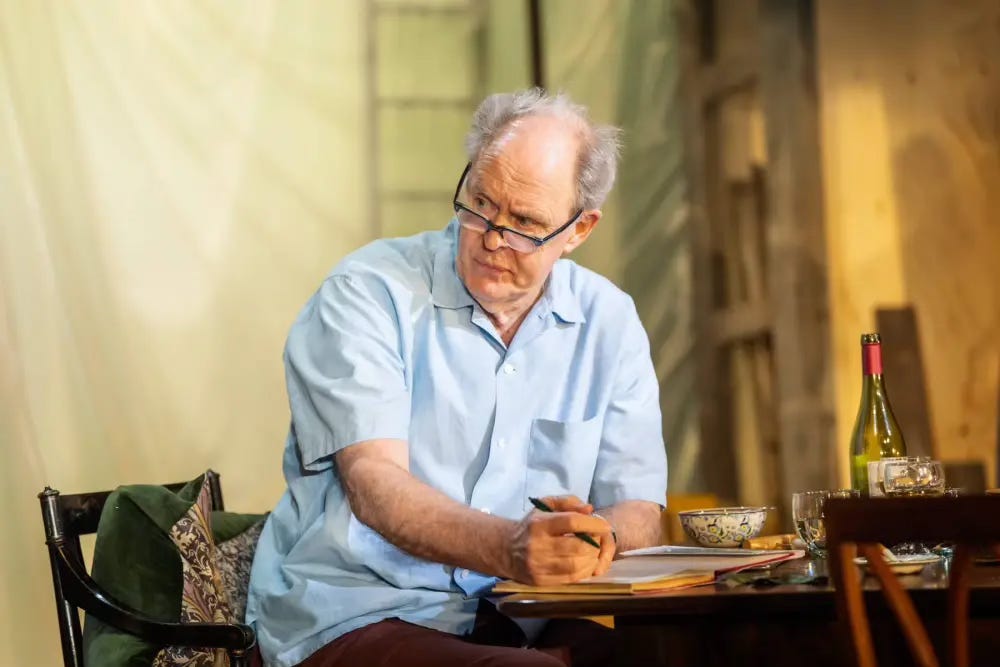
In “GIANT”, currently in previews on Broadway, beloved children’s author Roald Dahl (John Lithgow) plays a high stakes game with his literary reputation.
It is 1982 and Dahl has written a book review that passionately denounces Israel’s invasion of Lebanon and holds Jews collectively responsible the invasion. Two representatives of Dahl’s publishing company converge on his country home in attempt to persuade him to issue a public apology. Tom Maschler (Elliot Levey), Dahl’s British publisher and Jessie Stone (Aya Cash), sent from the New York publishing office. The stakes on the table are the potential loss of Dahl’s vast readership, his financial success as an author, and a possible knighthood. The knighthood is a particular fond hope of Dahl’s younger, upper class partner Felicity (Rachael Stirling).
What follows is a tense, well matched battle between Dahl and the three characters who want him to issue an apology. The subject of the battle are the nuances of antisemitism in its entanglement with criticism of Israel. The playwright Mark Rosenblatt has turned this abstract subject into a satisfying and consistently gripping play. But the core of the production’s success is John Lithgow’s perfomance. Lithgow at 80 is still at his peak. He embodies his Dahl with a charm that is both child-like in its sweetness and destructiveness. And Bob Crowley’s direction showcases Lithgow’s ability to keep the audience on its toes in a constantly shifting flipping of sympathies and antipathies. It’s grand theater.
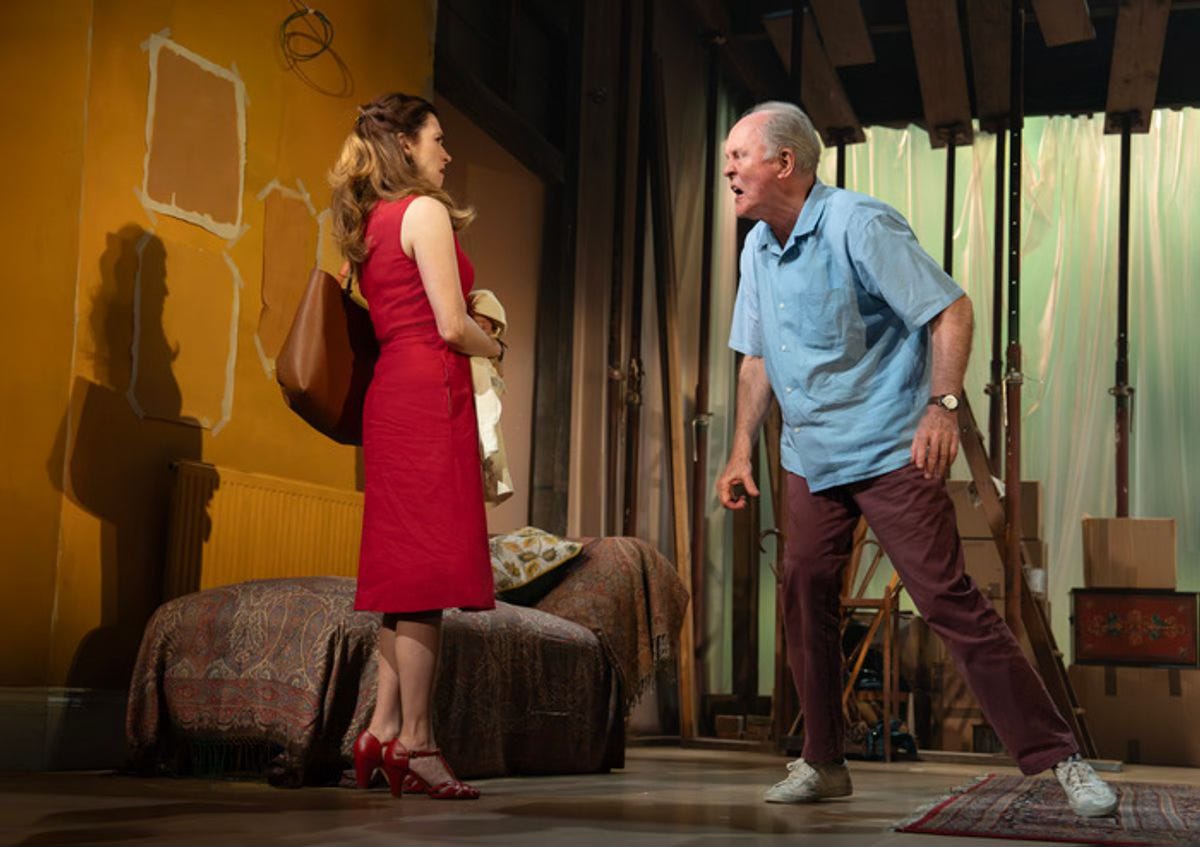
Jessie, the envoy sent from the American publishing house, becomes the primary antagonist in her attempt to corner Dahl into acknowledging that his anti-Zionism has merged with antisemitism. Aya Cash’s Jessie is petite and appealingly feminine but a serious pugilist. Her throwing down of the gauntlet to challenge Dahl ends the first act and makes us want to come back for the next match.
Before the play’s end, when Dahl delivers his infamous 1983 interview to The Spectator (quoted by the playwright verbatim) which is outrightly antisemitic, Dahl asks Jessie if she can no longer read his books to her son because:
“If it’s in me, then surely it’s in the books too?”
Jessie responds that she still loves his books. She can make a separation of Dahl, the antisemite, from Dahl, the literary genius. A separation that Dahl refuses to do when it comes to Jews and Zionism.
The plea that Jews as a diasporic community should be seen as separate from criminals like Netanyahu is an important one as synagogues are targeted in the US and Europe because of Israel and the US’s military actions. It is a plea that I share myself. But what the play elides or is perhaps complicit with in its elision is that the UK and other European governments have attempted to shut down political criticism of Israel by criminalizing it as antisemitism. And in the US, antisemitism has been criminalized as a tool by an authoritarian government to consolidate power. And beyond that, antisemitism is a visceral reaction, based on ancient hatreds and largely unsusceptible to a debate within the safe confines of the theater.
So after the audience rose to give Lithgow and the ensemble a deserved standing ovation and as soon as the actors had left the stage, I felt the applause switched off almost immediately like a light switch. Broadway, unlike the West End, is situated in a country where the debate over Israel is forcibly shut down long before it gets to the level where Rosenblatt is letting it play out. Only today, Laquaa Kordia, a student at Columbia University was finally released after a year in an ICE prison simply for exercising her first amendment rights by voicing her horror at the genocide in Gaza.